B1 Grammar · Perfect tenses
Present perfect with for and since
Use for and since with the present perfect to describe situations continuing from the past until now.
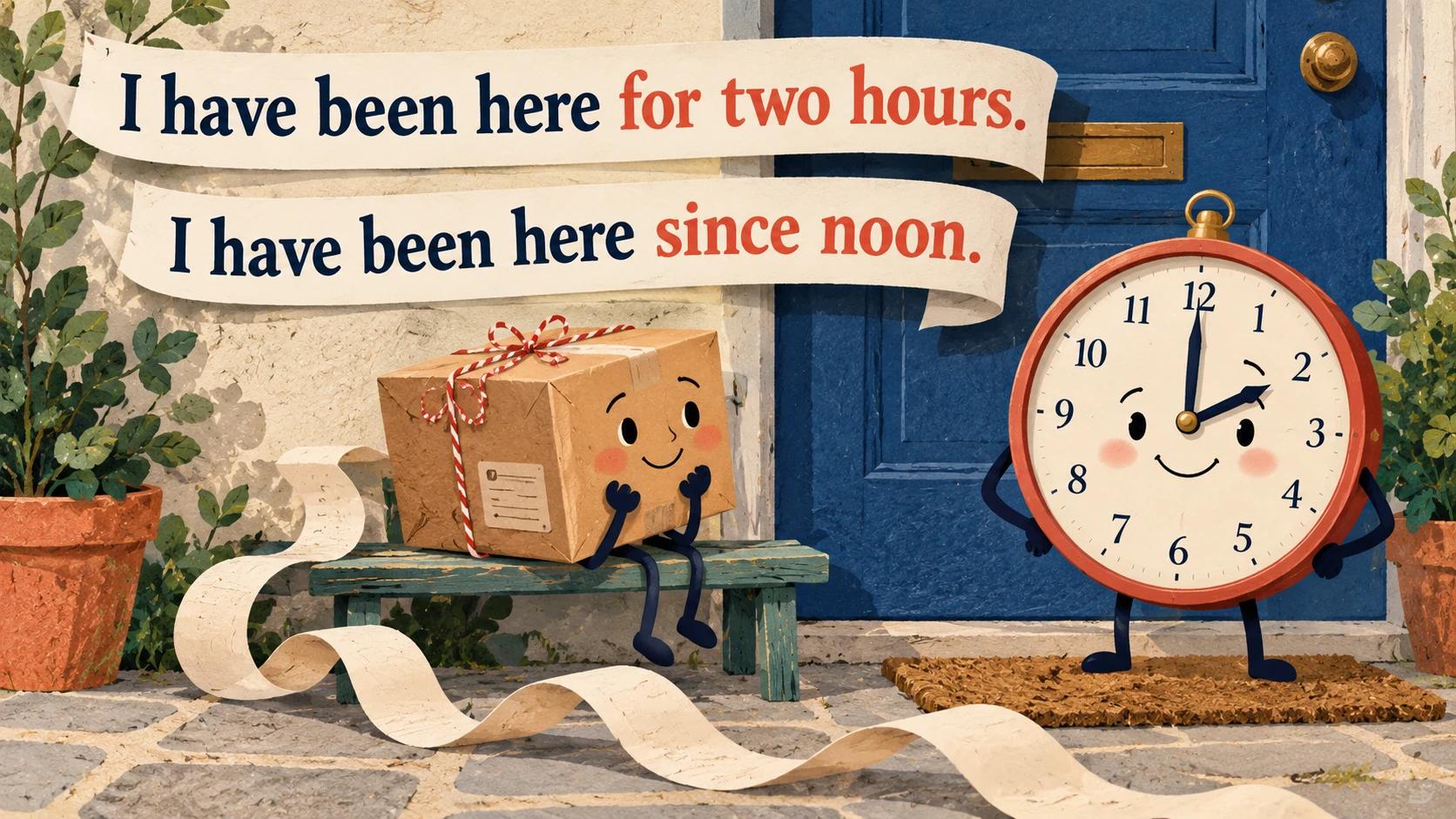
“I’ve lived here for three years” and “I’ve lived here since 2023” both describe a period that reaches the present. The words measure that period differently.
Duration or starting point?
Use for with a length of time: for two hours, for six months, for a long time.
Use since with the point when the period began: since Monday, since 2023, since I moved here.
- Nina has worked here for five years.
- Nina has worked here since 2021.
Both sentences tell us she still works here. The first answers How long? with a duration; the second answers Since when? with a starting point.
Draw the period before choosing the word
Imagine moving to a town in September 2023. In September 2026, you still live there:
September 2023 — move → three years living here → September 2026 — now
You can describe the same period in two ways:
I've lived here since September 2023. — name the beginning
I've lived here for three years. — measure the length
A date answers When did it begin? A duration answers How long has it lasted? That is the essential difference.
| Use for with a length | Use since with a beginning |
|---|---|
| for half an hour | since ten o'clock |
| for two weeks | since Monday |
| for several years | since 2023 |
| for a long time | since we first met |
Since I was a child gives the starting period. For my childhood does not express the same meaning and is not a natural replacement.
Ask the right question
How long have you known Eva? invites either answer: For six years or Since secondary school. You do not need to repeat the whole sentence in a short conversational reply.
Compare When did you meet Eva? This asks about the first meeting as a finished event, so the past simple is appropriate: We met in 2020. Knowing each other is the continuing state; meeting is the starting event.
Build the sentence
For an action or state that began in the past and continues now, use have/has + past participle:
subject + have/has + past participle + for/since + time
- We’ve known each other for years.
- He’s had this phone since January.
- How long have you lived in this town?
With since + clause, the starting event commonly uses the past simple: I’ve felt better since I changed my routine.
Compare with a finished period
- I’ve lived in Bristol for three years. I still live there.
- I lived in Bristol for three years. I am talking about a finished period; I may live somewhere else now.
The phrase for three years does not automatically require the present perfect. The time relationship decides the tense.
Duration can describe an activity or a state
I've worked here for a year and I've been working here for a year can both describe continuing work. The continuous version places more emphasis on the activity. With state verbs such as know and own, use the simple form: I've known her for a year, not I've been knowing her.
A negative can also describe a period up to now:
I haven't seen my cousin since January.
We haven't had a holiday for two years.
Here the period measures the absence of an event. It does not mean seeing or having a holiday has continued throughout that period.
The tense shows whether the period is finished
I worked at the café for six months describes a completed period of work. I've worked at the café for six months normally describes work continuing now. For works in both; it does not choose the tense.
You can also use for for a planned future duration: I'll stay for a week. Since in its time meaning looks backwards to a beginning, so it does not normally describe a future stay in that way.
A common first-language transfer is I live here since 2023. English usually needs the present perfect for this continuing period: I've lived here since 2023. Choose have/has, use the participle, then add the correct time phrase.
Try explaining a friendship in three connected sentences: We met at university in 2021. We've known each other since then. We've been friends for five years. The first gives the event; the next two describe the period reaching now.
Sources and further reading
Test this structure
Practise Present perfect with for and since
Try this structure in a focused practice set with instant scoring and clear explanations.
Start practicePrerequisites & related lessons
Keep building your B1 cluster
B1 Reading Practice Hub
Timed B1 Preliminary notices, matching, gapped text and cloze tasks.
Start B1 Reading 02 · Strategy GuideB1 Grammar Essential Structures
Core B1 Preliminary grammar patterns, examples and common errors.
Read guide 03 · Next LessonPresent perfect continuous
Use the present perfect continuous for activities continuing until now or causing a visible present result.
Open lesson