B1 Grammar · Noun phrases
Articles and quantifiers
Use articles, zero article and quantity words to distinguish general and specific meaning in B1 contexts.
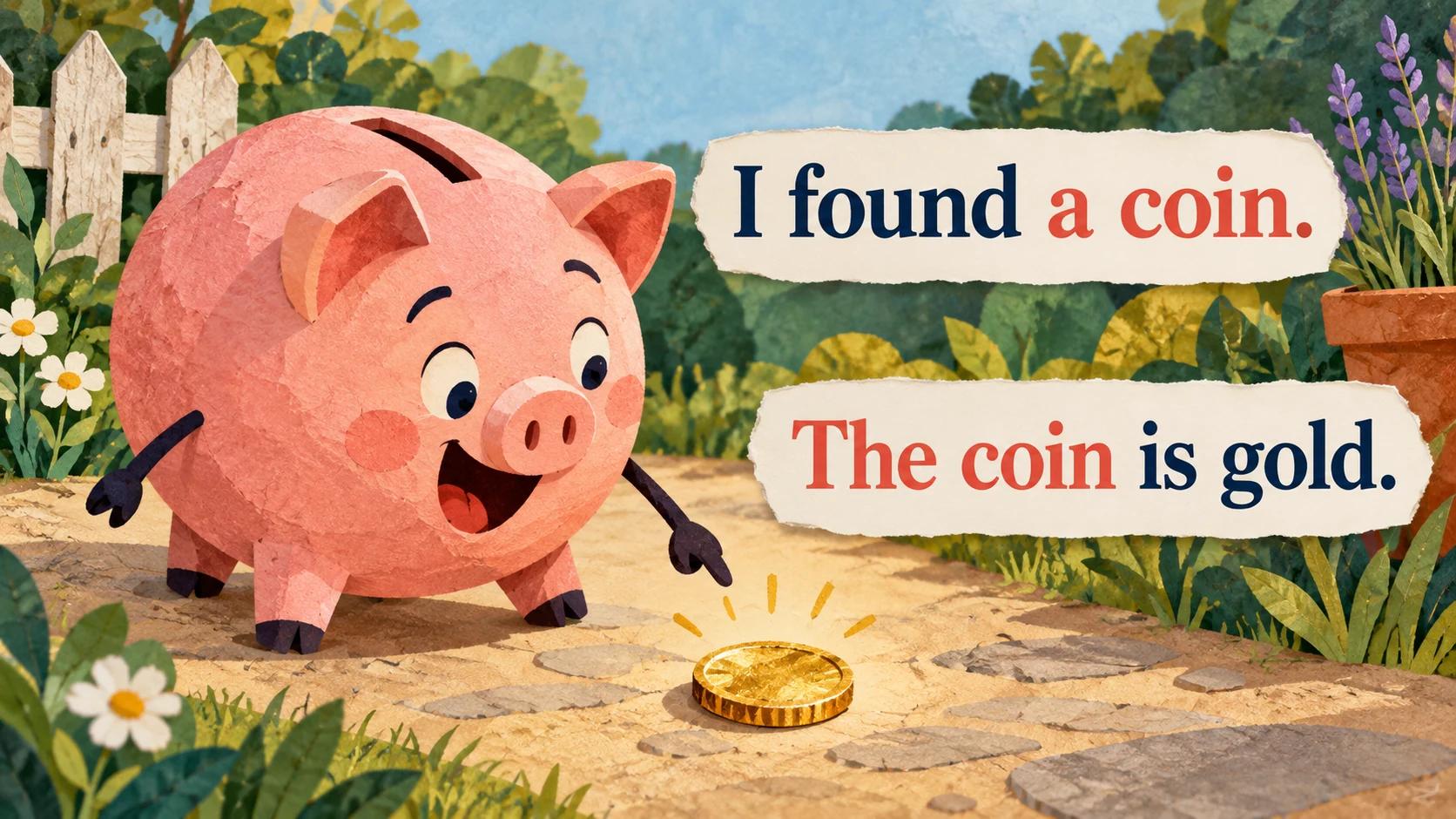
“I bought a book” introduces one book. “The book is excellent” points back to the book you now know. Small words guide the listener.
Choose an article from the noun and context
Use a/an with one singular countable noun when the listener does not yet know which one: I saw a dog. Choose an before a vowel sound: an umbrella, an hour.
Use the when the listener can identify the person or thing: The dog followed me home. It is now the dog just mentioned.
Use no article when talking generally about plural or uncountable nouns: Dogs need exercise. Water is important. A singular countable noun normally needs a determiner: a dog, the dog, my dog.
First decide whether you can count the noun
A countable noun has singular and plural forms: one apple, two apples. An uncountable noun normally names a substance, material or idea without separate counted items in that meaning: milk, rice, advice, information.
| Noun type | One item or an amount | A general statement |
|---|---|---|
| Singular countable | an apple, a chair | A chair needs to be comfortable. |
| Plural countable | some apples, three chairs | Apples are useful snacks. |
| Uncountable | some rice, a little milk | Rice is common in many dishes. |
Do not use a/an directly with an uncountable noun: an advice becomes some advice or a piece of advice. A container or unit can make an amount countable: two bottles of water, three pieces of information.
The helps the listener identify what you mean
I bought a notebook. The notebook is blue introduces an item, then refers back to it. But first mention can use the if the context identifies it: Please close the window is natural when both people can see the intended window.
Compare Books are expensive with The books on this shelf are expensive. The first is general; the second identifies a particular set. Uncountable nouns behave similarly: Water is important, but The water in this bottle is cold.
A/an follows sound rather than spelling: a university, an hour, an old book. If an adjective comes before the noun, its first sound matters too.
Add a quantity word
Some is common in affirmative statements: We bought some apples and some milk.
Any is common in questions and negatives: Do you have any milk? We don’t have any apples.
Use many with plural countable nouns and much with uncountable nouns: many books, much water. A lot of works with both: a lot of books, a lot of water.
Few/a few go with countable nouns; little/a little go with uncountable nouns. Adding a makes the amount sound more positive: We have a little time suggests some time is available; We have little time stresses a shortage.
Compare in context
I need a chair. Any suitable chair will do.
I need the chair by the door. The listener can identify it.
I need some chairs. The number is not exact.
Choose quantity and attitude together
Use many with plural countable nouns: many questions. Use much with uncountable nouns: much homework. In positive everyday statements, a lot of is often more natural: We have a lot of homework.
In questions and negatives, much/many are common: How much time do we have? There aren't many seats left.
A few means some countable items; a little means some uncountable amount. Without a, few/little often stress a shortage:
We have a few chairs, so the small group can sit down.
We have few chairs, so most people will have to stand.
The exact number can be the same; the speaker presents it differently.
Some and any are useful tendencies, not absolute rules
Some is common in positive statements; any in negatives and ordinary questions. But offers and requests often use some: Would you like some tea? Could I have some water? The speaker offers or expects a positive amount.
Positive any can mean “whichever”: Choose any seat. This differs from We don't have any seats left, where any occurs under a negative.
Imagine preparing lunch:
We need some bread and a few tomatoes. Do we have any cheese? There isn't much milk, but we have enough for coffee. The bread in the cupboard is fresh.
Each small word has a role: unspecified amount, small number, availability, limited amount, sufficient amount, or identified item.
To choose an article or quantity word, ask three questions: Can I count this noun in this meaning? Does the listener know which item or amount? How much or how many do I want to describe? These questions are more useful than trying to memorise every possible noun phrase.
Sources and further reading
Test this structure
Practise Articles and quantifiers
Try this structure in a focused practice set with instant scoring and clear explanations.
Start practiceKeep building your B1 cluster
B1 Reading Practice Hub
Timed B1 Preliminary notices, matching, gapped text and cloze tasks.
Start B1 Reading 02 · Strategy GuideB1 Grammar Essential Structures
Core B1 Preliminary grammar patterns, examples and common errors.
Read guide 03 · VocabularyB1 Topic Vocabulary Hub
High-frequency B1 collocations, phrasal verbs and everyday idioms.
Open B1 Vocab