Part 3 · Word Formation
Word Formation: Prefixes, Suffixes & Roots
Part 3 gives you a base word and asks you to transform it to fit the gap. Often you need to change the word class AND add a prefix. This guide covers every transformation you need to know.
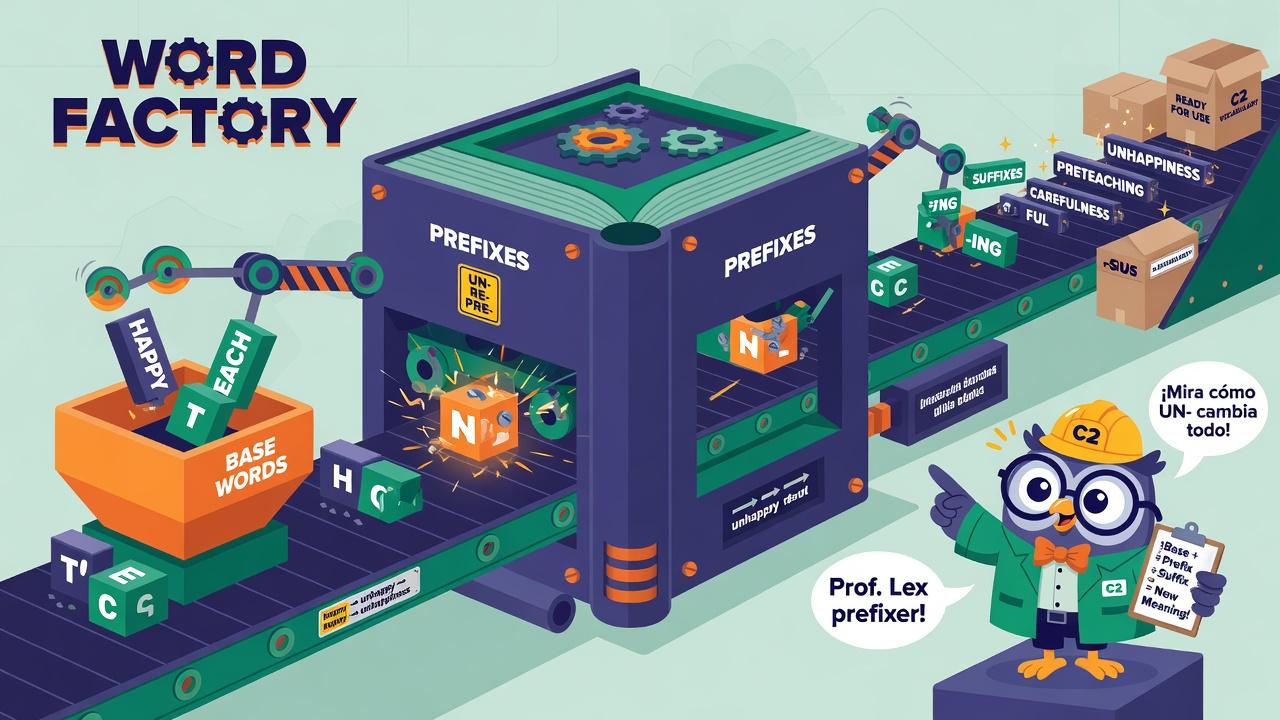
How do you approach C2 Proficiency Part 3 Word Formation?
In 2026, Cambridge C2 Part 3 gives 8 base words to transform into nouns, verbs, adjectives, or adverbs. Ask three questions: what word class is needed, which suffix applies, and whether a negative prefix is required. About 30% of gaps need negative forms.
Step-by-step guide
How to Master C2 Proficiency Word Formation
Step-by-step method to excel at Part 3 Word Formation in the Cambridge C2 Proficiency exam.
- Identify the required word class
Look at surrounding syntax: an article before the gap usually signals a noun; before a noun signals an adjective; modifying a verb signals an adverb.
- Apply the matching suffix or prefix
Build the correct derivative and test whether sentence polarity demands a negative prefix (un-, dis-, in-, im-, ir-, il-).
- Watch for internal spelling shifts
Check vowel changes, dropped -e, or doubled consonants (e.g. wide → width, argue → argument, refer → referral).
- Check for irregular & plural forms
Confirm whether countable nouns need a plural -s or whether a less common C2 derivation fits the register.
- Re-read the completed clause
Verify exact spelling and ensure the transformed word reads naturally inside the full paragraph.
What 3 Questions Should You Ask Before Each Gap?
Look at the surrounding words. Article before gap → noun. Before a noun → adjective. Modifying a verb → adverb.
Match the base word to the correct suffix. Remember spelling changes (e.g. happy → happiness, not happyness).
Re-read the sentence. Is the meaning negative? You may need BOTH a prefix AND a suffix applied to the base word.
Which Suffixes Create Nouns, Adjectives & Verbs?
Noun Suffixes
-tion / -sionformation, persuasion, reduction-mentachievement, improvement, assessment-nesshappiness, weakness, awareness-ity / -tycreativity, ability, certainty-ance / -enceperformance, existence, significance-ism / -istcriticism, journalist, optimismAdjective Suffixes
-ful / -lesspowerful, meaningful / careless, endless-ive / -ativecreative, communicative, active-ous / -iousambitious, obvious, mysterious-able / -iblereliable, flexible, permissibleVerb Suffixes
-ifyclarify, simplify, intensify-ise / -izerealise, prioritise, organise-enstrengthen, widen, broadenWhy Are Negative Prefixes the #1 Part 3 Trap?
About 30% of Part 3 answers require a negative prefix. Choosing the wrong one (e.g. “unresponsible” instead of “irresponsible”) costs the mark immediately.
| Prefix | Rule | Examples |
|---|---|---|
un- | Most common — adjectives & past participles | unhappy, unexpected |
in- / im- / ir- / il- | im- before m/p, ir- before r, il- before l | impossible, irresponsible |
dis- | Opposite action for verbs | disagree, disappoint |
mis- | Incorrectly or wrongly | misunderstand, mislead |
over- / under- | Too much / too little | overestimate, underpaid |
Which Spelling Changes Trip Up C2 Candidates?
y → i before suffix
keep the -e before consonant suffix
drop the -e (not "arguement")
not "absorbtion"
-t → -ss before -ion
double r before stressed vowel suffix
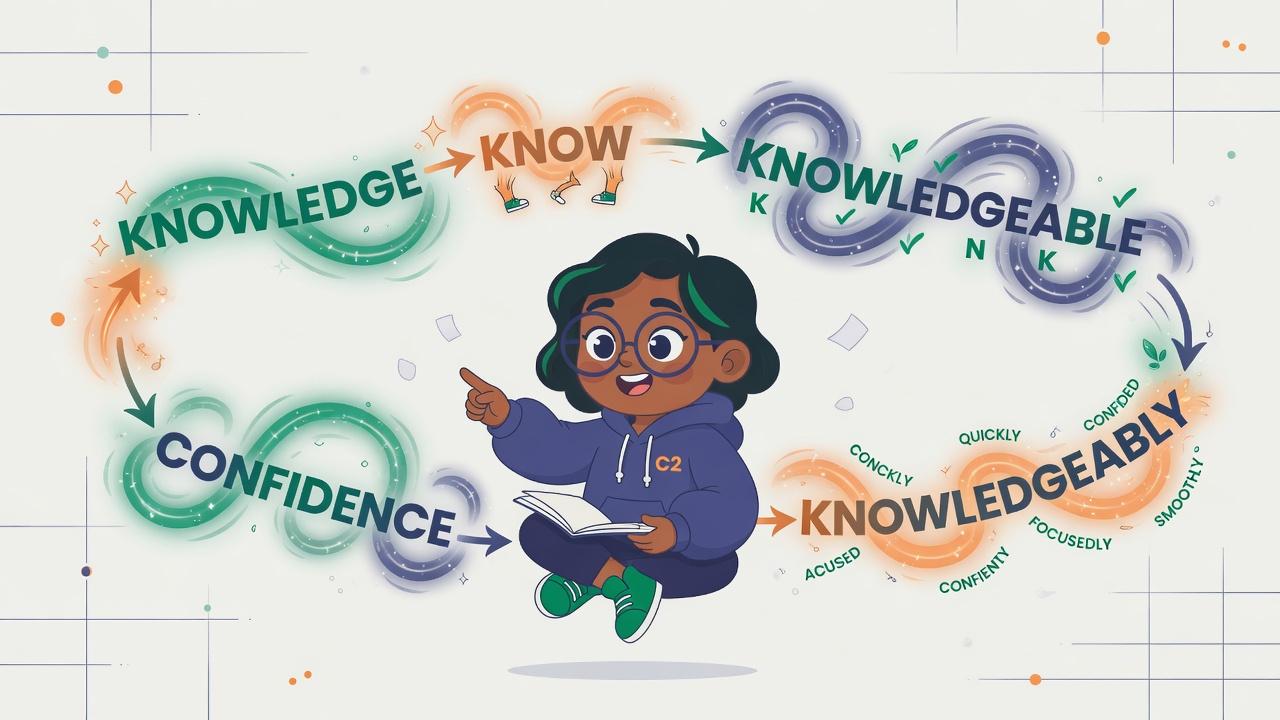
Apply Part 3 rules
Ready to test your Word Formation?
Practise transforming base words in context with our free Part 3 exams and instant spelling feedback.
Start Part 3 practice nowKeep building your C2 cluster
C2 Use of English Practice
Exam-calibrated CPE Parts 1–4 drills with instant marking.
Start C2 UoE 02 · Related GuideC2 Proficiency Exam Structure Guide
Timing, parts and mark weightings across all four CPE papers.
Read guide 03 · FoundationC2 Complex Negative Inversion
Master high-register inversion triggers for CPE Part 4 and essays.
Open lessonWhere Are Word Formation Rules Defined Officially?
- Cambridge University Press & Assessment: C2 Proficiency Teachers Handbook — retrieved 2026-06-11
- Cambridge University Press & Assessment: C2 Proficiency exam overview — retrieved 2026-06-11
- Cambridge University Press & Assessment: Cambridge English Scale — retrieved 2026-06-11