Part 1 · Multiple Choice Cloze
Multiple Choice Cloze: Mastering Collocations & Idioms
Part 1 of the Use of English paper might look simple — four options, pick one — but at C2 level, all four options are grammatically correct. The difference is always about meaning, collocation or register.
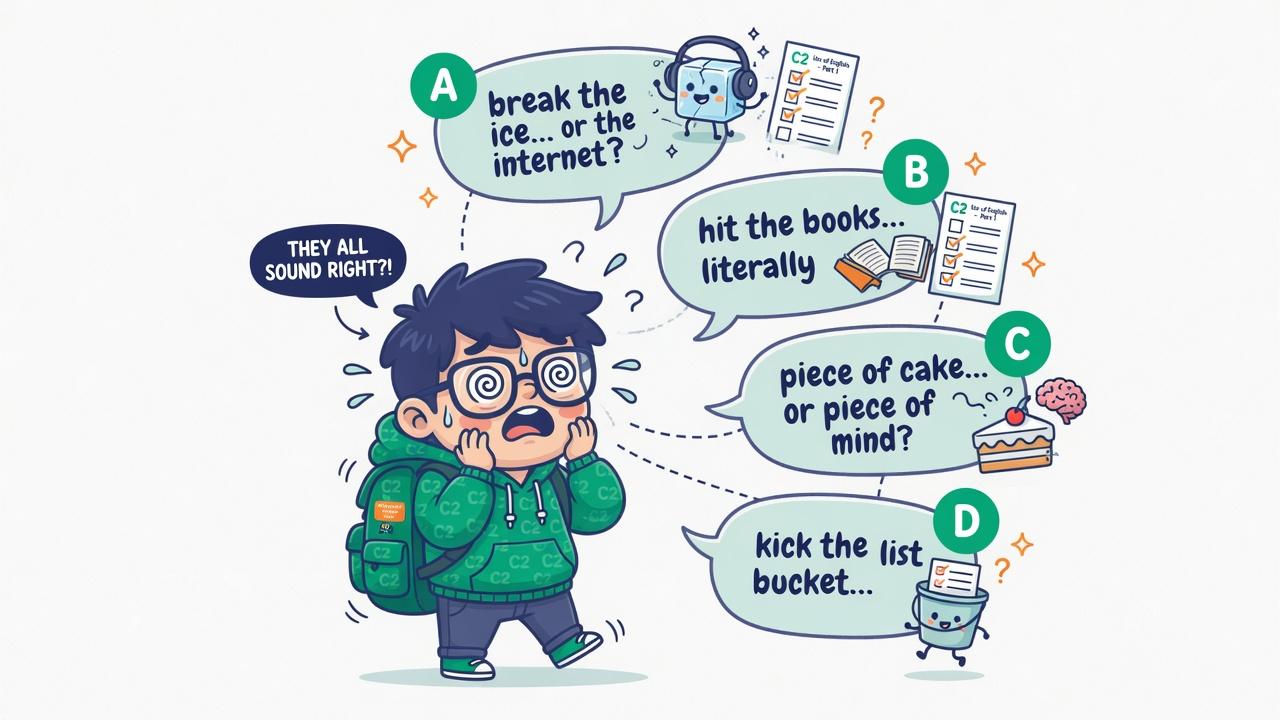
How do you solve C2 Proficiency Part 1 Multiple Choice Cloze?
In 2026, Cambridge C2 Part 1 has 8 gaps with four options each — all grammatically correct. Read the full text first, eliminate two distractors, then choose the answer with the most natural collocation or idiom. Spend about 12 minutes total on this section.
What Exactly Does Part 1 Test?
Part 1 consists of a text with 8 gaps. For each gap, you choose from four options (A, B, C, D). The correct answer always depends on one of these four lexical categories:
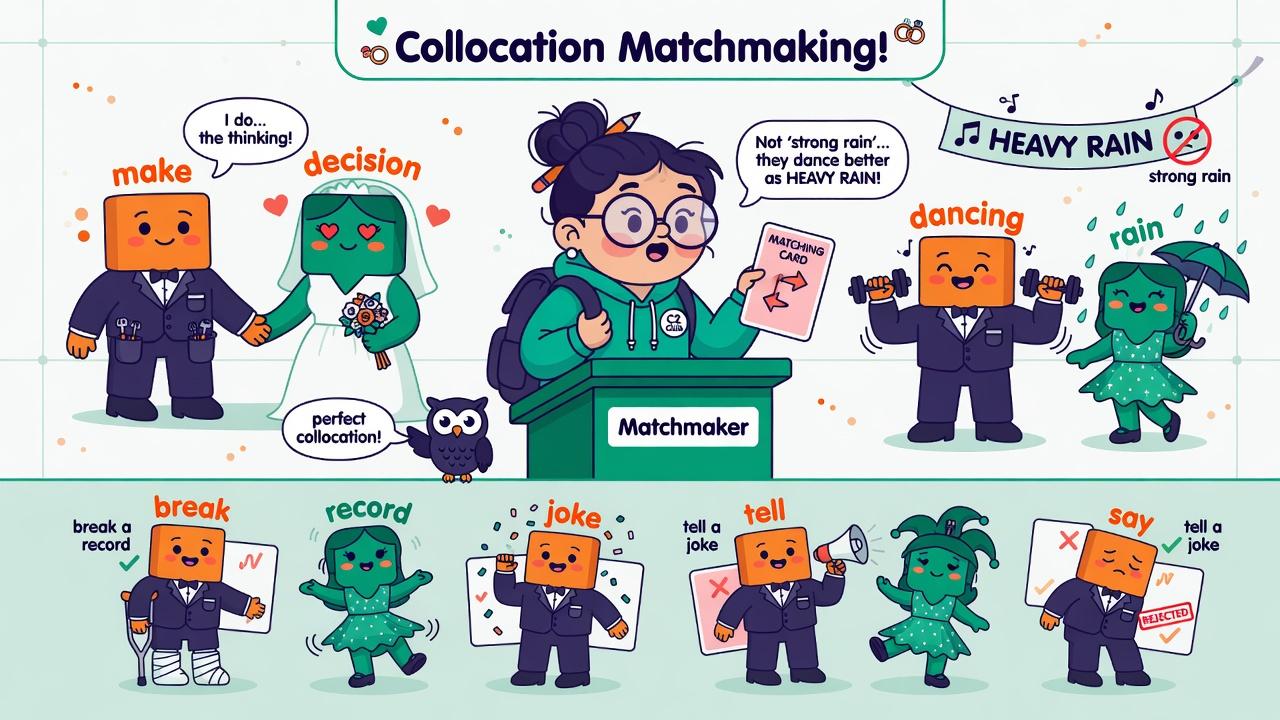
Which word "sounds right" with the surrounding words (e.g. make a decision, not do a decision).
Set expressions with meanings that cannot be guessed literally (e.g. the tip of the iceberg).
Multi-part verbs where the particle changes the meaning (e.g. put up with vs put off).
Words that are near-synonyms but differ subtly in nuance or register (e.g. slim vs thin vs slender).
How Does the 4-Step Elimination Strategy Work?
Step-by-step guide
The 4-Step Elimination Strategy for C2 Multiple Choice Cloze
A systematic method to tackle even the trickiest lexical distractors in Part 1.
- Read the whole sentence
Never look at the gap in isolation. Read 5 words before and 5 words after the gap to understand the full context.
- Identify the grammatical context
Notice prepositions, articles and surrounding verbs. Many collocations are locked to specific prepositions (e.g. "consistent with", not "consistent to").
- Eliminate two options
Usually two options are clearly wrong because they do not collocate. Remove these first to sharpen your final choice.
- Test the remaining two
Say both sentences mentally. Choose the option with the most natural collocation, tone, and register at C2 level.
Which Collocations Appear Most Often in Part 1?
These verb–noun collocations appear repeatedly in CPE Part 1 exams. Memorise them as chunks, not individual words:
| Collocation | Common Distractor | Context |
|---|---|---|
| make a decision | do a decision | After long deliberation, she ___ a decision. |
| reach an agreement | arrive at an agreement | Both sides finally ___ an agreement. |
| raise awareness | grow / lift awareness | The campaign aimed to ___ awareness. |
| conduct research | do / make research | Scientists ___ extensive research. |
| set a precedent | create / make a precedent | The ruling ___ a landmark precedent. |
| come to terms with | accept / settle with | She struggled to ___ her diagnosis. |
| take something for granted | assume / take as given | We often ___ clean water for granted. |
| draw a conclusion | make / take a conclusion | From the data, we can ___ this conclusion. |
What Pro Tips Boost Your Part 1 Score?
At C2, avoid is not the same as shun, and prevent is not the same as hinder — context determines which fits.
Often the options differ only in the preposition they require. Check what follows the gap (e.g. "insist on doing" vs "persist in doing").
Some options are too informal for an academic or journalistic text (e.g. "get" vs "obtain"). Read the passage tone before choosing.
Each question is worth 1 mark. Do not spend 5 minutes on one gap — flag it and come back if time allows.
Apply Part 1 tactics
Ready to test these strategies?
Apply everything from this guide with our free Part 1 practice exams and immediate feedback on every answer.
Start Part 1 practice nowKeep building your C2 cluster
C2 Use of English Practice
Exam-calibrated CPE Parts 1–4 drills with instant marking.
Start C2 UoE 02 · Related GuideC2 Proficiency Exam Structure Guide
Timing, parts and mark weightings across all four CPE papers.
Read guide 03 · FoundationC2 Complex Negative Inversion
Master high-register inversion triggers for CPE Part 4 and essays.
Open lessonWhere Are Part 1 Rules Defined Officially?
- Cambridge University Press & Assessment: C2 Proficiency Teachers Handbook — retrieved 2026-06-11
- Cambridge University Press & Assessment: C2 Proficiency exam overview — retrieved 2026-06-11
- Cambridge University Press & Assessment: Cambridge English Scale — retrieved 2026-06-11